Emmy-winning FPV & cinema drone showreel by Lewis Whyld. Shot for HBO, CNN & Warner Bros. Featuring RED Komodo Cinelifters, DJI Inspire 3, and bespoke Cinewhoops.
Specialist Aerial Cinematography
From premium brand campaigns and boutique property fly-throughs to broadcast credits for HBO, CNN, and Warner Bros. Discovery, Lewis Whyld provides a cinematographer-first approach to every project. Whether it’s a high-speed vehicle chase or a precision indoor tour, we provide scalable solutions for agencies, brands, and broadcasters of all sizes.
High-Performance Drone Cinematography
Our bespoke fleet is designed for, and tested in, the world’s most demanding environments. From the high-pressure sets of major motion pictures, the busy streets of London and Venice, to hostile deployments in the Arctic, Ukraine, and Chernobyl.
The Technical Fleet
- Heavy-Lift FPV: Custom-built Cinelifters for Arri Alexa Mini & RED Komodo payloads.
- Precision Gimbal: DJI Inspire 3 for 8K ProRes RAW & CinemaDNG delivery.
- Specialist Interiors: Sub-250g Cinewhoops for safe, permitted indoor filming.
- Bespoke builds: Including a cinewhoop with class-leading flight times allowing for stress-free/multiple takes.
Safety & Compliance
- CAA Approved (GVC & A2 CofC) | EASA Certified (A1-A3 & STS)
- Full Public Liability Insurance (£10M+) | Worldwide Carnet & Logistics
Iceland - The Land of Fire and Ice.
CNN sent me to Iceland with a mission: do the country justice.
That’s a daunting task in such an iconic but harsh landscape.
I could tell you about hurricane-force winds
or record snowfall that made crossing the country almost impossible. I could tell you about standing on a mountain all night at -15C, with the wind howling in my face. Or even about hiking to an erupting volcano in the dark… and flying a drone into it.
But watch the film and you’ll forget all of that.
Because this is the land of fire and ice. It's a place where the floor is lava, the sky is emerald green and the rainbows are upside down. And if you watch all the way through… enjoy the last shot. It’s literally fire.
Technical Specs: Shot for CNN using bespoke, weather-hardened and fire-proofed FPV Drones in sub-zero and hurricane-force conditions.
CNN Iceland assignment: Extreme environment FPV drone filming by Lewis Whyld. Cinematic proximity flight into active volcanic eruptions and Northern Lights capture. Operating in sub-zero temperatures and hurricane-force winds with bespoke RED Komodo Cinelifters for global broadcast.
Chernobyl
Specialist drone cinematography for the CNN companion to the Emmy-Winning HBO 'Chernobyl' series. Capturing the scale of the New Safe Confinement (Sarcophagus), a structure larger than Wembley Stadium, and exploring the abandoned exclusion zone to document the surge in post-series tourism.
Technical Operations in Hostile Environments
The shoot required rigorous hostile environment protocols, including radiation monitoring and specialized flight procedures for highly contaminated areas. Lewis provided the calm technical leadership needed to operate safely in one of the world’s most restricted and hazardous environments.
Restricted airspace drone filming in Chernobyl by Lewis Whyld for CNN. Expert in hostile environment aerials, radiation safety protocols, and complex permitting. Cinematic FPV and drone cinematography at the Reactor 4 Sarcophagus and Pripyat.
Greenland and the Arctic.
CNN wanted a film that made the Greenland look amazing. I had a handful of days to create something special in one of the most inhospitable places on the planet.
So I started studying. I watched the light. Read the wind. Learned the rhythms of ice and sea. I thought through every shot and every move and prepared my kit, building new drones for extreme environments no one had operated in.
People said my ideas were too ambitious. Many they laughed at. Flying in icy winds at Summit Station? Getting close to Helheim’s walls of ice with a drone? Wildlife shots in a narrow timeframe? Interviews in ridiculous locations? Impossible. Not worth it.
Then, early in the trip, Greenland made its point.
We were out on a glacier getting shots of melting ice. A fellow photographer took one step… and vanished. Without warning or drama he dropped into a hidden ravine, a hole disguised by snow, the only thing that stopped him was the tripod he was holding. It snagged the edge and he was left dangling in mid-air.
I didn’t have time to think, I got down flat, crawled to the lip, grabbed him so hard he complained I was hurting him, and hauled him out inch by inch, thinking the ice could give way under both of us at any second.
When he was safe, I looked down into the hole. Hundreds of feet below there was a fast-moving river of water ripping straight under the ice sheet. That was the wake-up call. One wrong move and you’d be under the glacier. Gone.
Then the cold, with lows of -50°C it's so cold it’s dangerous. Camping is brutal. One morning I woke to find my mouth literally frozen shut. Batteries died in seconds. Touching the air was painful.
Back at sea level we were on a speedboat punching through ice, windchill from hell, salt spray freezing wherever it landed. I’d planned for cold but this was something else.
Then the wildlife, all of it beautiful but unpredictable. You earn fleeting opportunities by watching, waiting and learning behaviour, but we had to do it in a compressed timeframe.
Somewhere in the middle of the creaking ice, numbed fingers, constant calculation of risk I started pushing. What’s the point of dreaming it if you don’t actually do it?
Helheim Glacier was a challenge. A cathedral of ice to fly into. Summit Station's cold was something to document. I kept chasing the shots I’d been told were too ambitious because I knew what the story needed.
Greenland doesn’t just test your skill it tests your judgement and patience.
The result was worth it.
We made a portrait of a territory that is now in the crosshairs of global politics, showing it as it actually is: colossal, fragile, violent, beautiful. A place that demands payment in blood, sweat and tears before it gives anything back.
We did it against the odds, the elements and a glacier that nearly swallowed one of us whole; I was fortunate that it led to my first Emmy nomination for ‘Outstanding Video Journalism in News’.
A reminder that nothing good comes easy.
Technical Note: Filming at Summit Station and Helheim Glacier required bespoke, winterised drone builds to operate at -50°C. High-altitude and sub-zero battery management protocols were developed specifically for this Emmy-nominated CNN assignment.
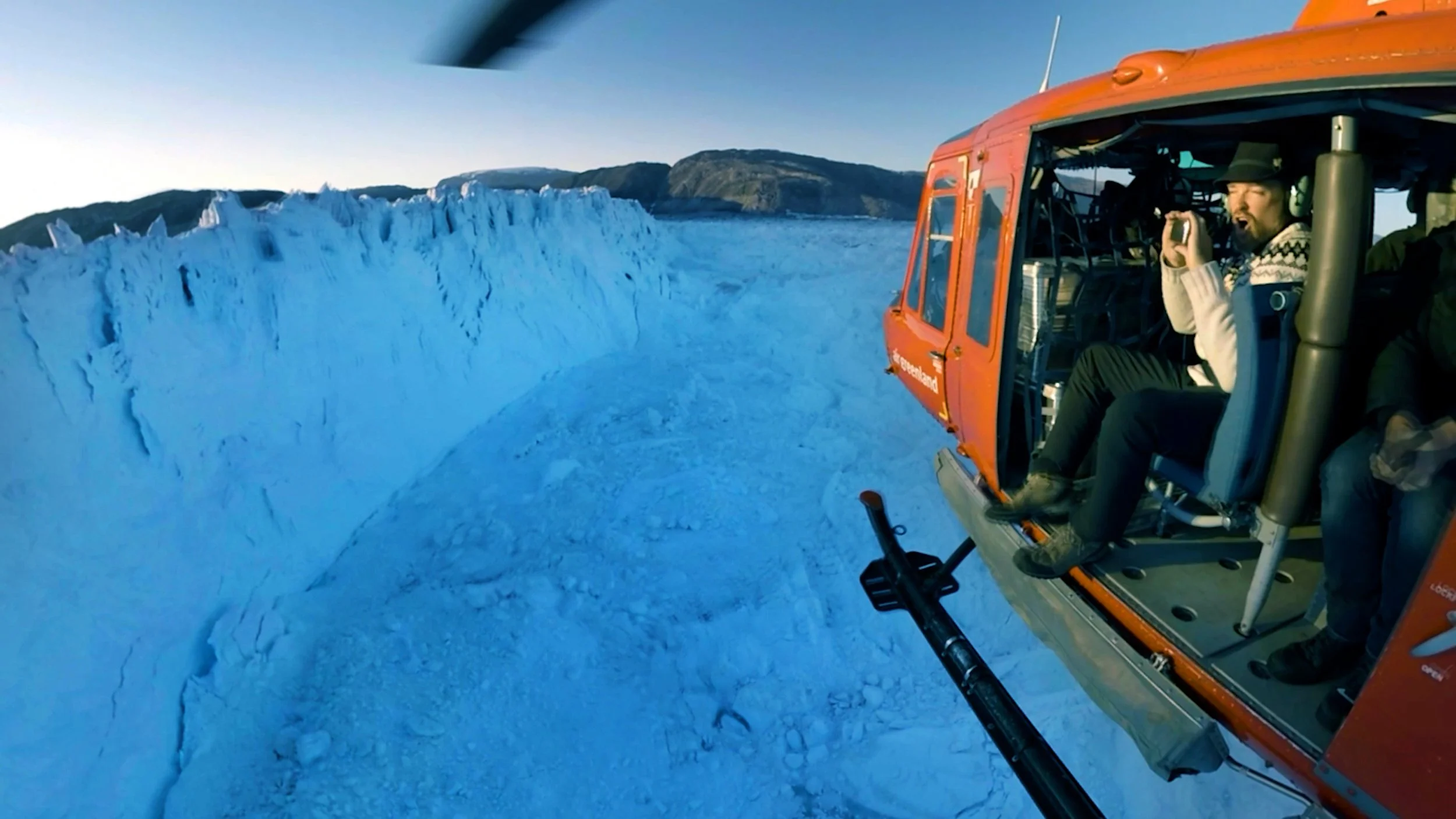
Emmy-nominated FPV drone filming in Greenland by Lewis Whyld for CNN. Specialist in sub-zero aerial cinematography (-50°C) at Summit Station and Helheim Glacier. Expert in extreme weather drone operations, bespoke cold-weather builds, and high-altitude video journalism.
Venice - Masterclass in City drone shooting
This is Venice.
CNN wanted a film that made the city feel alive. They wanted it breathing and moving, busy yet beautiful.
If you’ve been you’ll know, if you haven’t, Venice is a unique place, a city on the water and one of the most beautiful, yet challenging, locations on earth.
I had a couple of days to create something special in one of the most complicated airspace you can operate a drone. Water everywhere. Tight spaces. Tourists, boats, bridges, wires, wind tunnelling through alleyways. Nowhere to “just land.” No margin for error.
Safety is always the primary concern, so I started studying - literally. I needed extra qualifications just to fly in the airspace. I took exams. Got the licences. Did paperwork. Planned routes. Built kit around the reality of Venice, not the fantasy of it.
I was operating in a GPS-denied environment, flying between stone walls with wind tunnels often with no place to land except a moving boat. One mistake and the drone is at the bottom of a canal.
Beyond the dangers was the the pressure of the clock. Venice is light. Venice is reflection. Venice is rhythm. Miss the moment and the city turns flat. Hit the moment and it lives.
So I watched the sun and the shadows. I tracked the flow of boats. I learned when streets filled and emptied and when the canals opened. I built the film shot by shot, move by move, from sunrise to sunset.
I kept chasing the shots in my mind, the ones that showed Venice in motion. The wake cutting through gold water. The city folding in close around you. The texture, the speed, the life between the landmarks.
This is the result, a portrait of the city as it lives and breathes: beautiful, chaotic, delicate… alive. Have you ever been?
(DM for commissions, shoots or just to chat about projects you're working on that might need epic cinematic shots and aerials.)
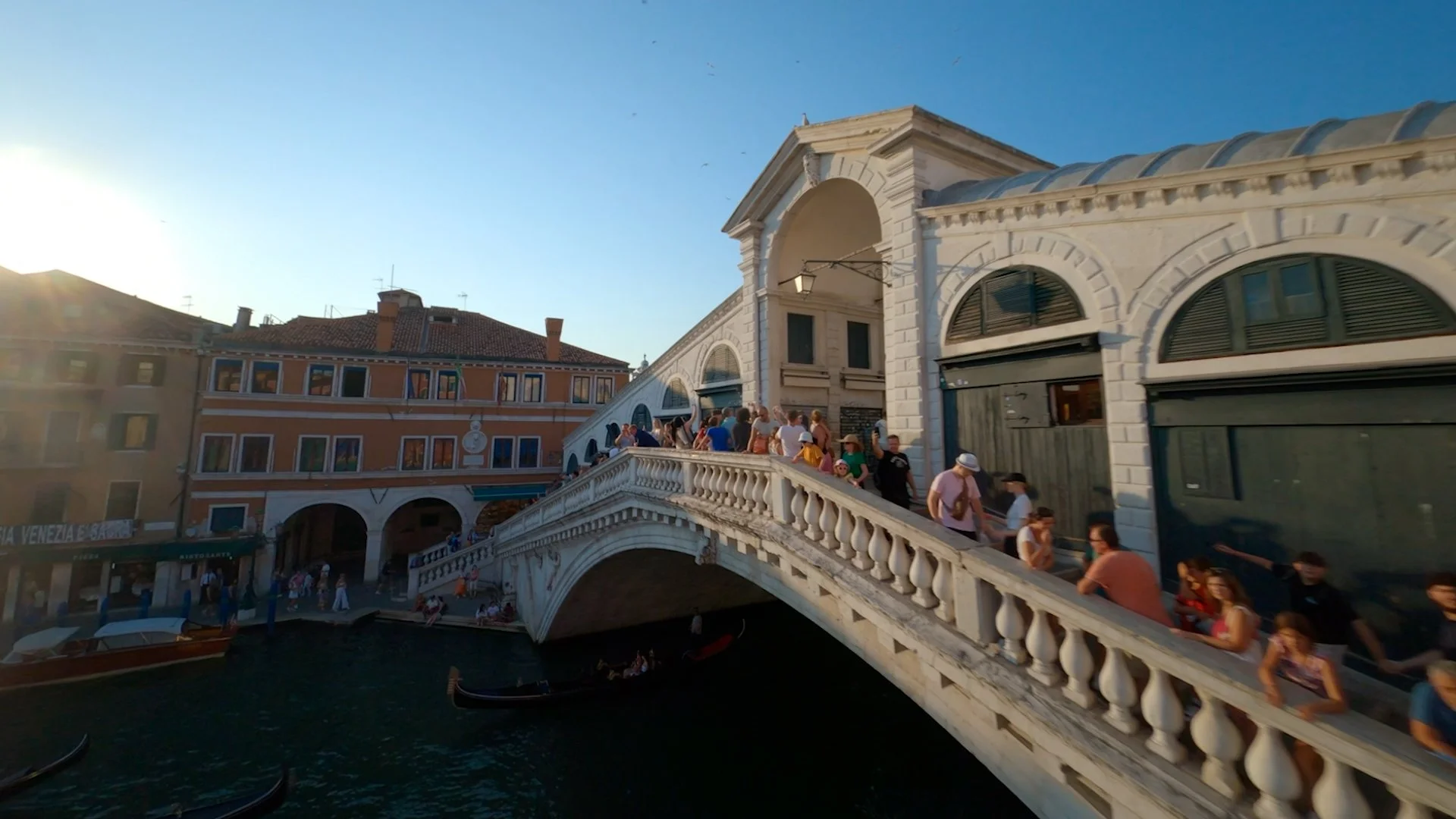
Specialist FPV drone filming in Venice, Italy by Lewis Whyld for CNN. Expert in GPS-denied flight, complex urban airspace, and Italian ENAC drone permitting. Cinematic FPV fly-throughs and aerial cinematography using bespoke Cinewhoops and DJI Inspire 3 for global broadcast.
Humanitarian Crisis: Award-Winning Broadcast Coverage
The Refugee Crisis.
Cinematic drone cinematography documenting the refugee journey to Europe for CNN news packages and documentaries. This internationally acclaimed coverage was featured in my “Life in a Camp” exhibit at the Imperial War Museum as part of their ‘Refugees Season,’ highlighting the perilous nature of small boat crossings and displacement camps.
Norfolk: The World’s Largest Medical Cannabis Farm
Finding the Spiritual in the Industrial…
When the call came in that I was filming at one of the largest cannabis farms in the world, I assumed I was heading somewhere exotic. I actually ended up in Wissington, Norfolk.
I arrived at 5:00 AM to catch the sunrise hitting 18 hectares of glass. From above, the geometric landscape felt almost spiritual—a perfect mathematical grid glowing in the first light. Flying the drone inside among the plants was a rare opportunity to document a crop used to create life-changing medicines for children with rare forms of epilepsy.
It’s proof that even "unobvious" locations hold striking visuals when you have the right perspective.
Technical Note: Precision indoor FPV fly-throughs and heavy-lift gimbal aerials. Shot with bespoke Cinewhoops to navigate the delicate internal canopy and 18 hectares of glass infrastructure.
Industrial indoor FPV drone filming in Norfolk, UK by Lewis Whyld. Specialist in large-scale greenhouse and medical facility aerials. Precision indoor fly-throughs using bespoke Cinewhoops for corporate and pharmaceutical brand films.
CNN New Year’s Eve: Craig David Live
Indoor FPV Cinewhoop filming Craig David for CNN Anderson Cooper New Year's Eve by Lewis Whyld. Live broadcast FPV drone filming for CNN New Year's Eve with Anderson Cooper. Indoor Cinewhoop drone cinematography for Craig David performance. Specialist in live event FPV, celebrity music performances, and precision indoor drone tours by Lewis Whyld.
Filming for Anderson Cooper’s 2022 New Year’s Eve Show on CNN. This required a precision indoor FPV Cinewhoop to capture a dynamic, live performance by Craig David. This was an internal FPV flythrough with A-list talent performing live.
In a high-stakes broadcast environment with moving talent, lighting rigs,and a global audience, there is no "take two." The flight required absolute technical reliability and a safety-first approach to indoor proximity filming.
CNN: Normandy & the 75th Anniversary of D-Day
Specialist drone filming in Normandy, France for CNN D-Day 75. Expert in French DGAC drone permitting, ABMC site coordination, and heritage site aerial cinematography. Cinematic drone filming of Omaha Beach and Normandy American Cemetery by Lewis Whyld. Specialist in international restricted airspace operations.
Filming for CNN’s 75th Anniversary of D-Day was a project of immense historical weight and regulatory complexity. Capturing the vast scale of Omaha Beach and the Normandy American Cemetery required months of high-level coordination with French civil aviation (DGAC), local prefectures, and the American Battle Monuments Commission (ABMC).
Navigating some of the most restricted and sensitive airspace in France, we delivered cinematic 4K plates that honoured the landscape while adhering to rigorous heritage protection protocols. This project remains a benchmark for our ability to manage international permits and safe operations at world-class historical sites.
High-Speed Vehicle Pursuit: Drifting at King’s Lynn
Automotive FPV drone chase and vehicle tracking at King's Lynn, England by Lewis Whyld. Specialist in high-speed drifting cinematography, close-proximity FPV, and bespoke chase drone builds. Expert in automotive commercial filming, professional drifting pursuit, and cinematic vehicle tracking for brands.
Redefining the limits of automotive cinematography. Filming professional drifting at the King’s Lynn circuit required a bespoke, high-performance FPV rig specifically engineered for ultra-close proximity.
Moving beyond standard flight profiles, this new style of FPV drone allows us to "lock in" to the car’s line, bringing the audience closer to the tyre-smoke and the door-to-door action than ever before. This is precision vehicle tracking at its most visceral—built for high-end automotive brands and high-octane commercial campaigns.
CNN & Warner Bros. Discovery: Advanced Indoor FPV fly-through
Advanced indoor FPV drone fly-through of Warner Bros. Discovery London by Lewis Whyld. Specialist in complex office tours, multi-floor signal penetration, and precision Cinewhoop flight. Expert in commercial real estate FPV, architectural drone filming, and London property tours.
Navigating the high-spec interiors of Warner Bros. Discovery’s London HQ required more than just forward flight. To do a world-class space justice, we utilised advanced manoeuvres - backwards flight, orbits, and precision gap threading - to create a continuous, immersive narrative.
Using bespoke kit designed for maximum signal penetration across multiple floors, this one-shot tour demonstrates how FPV can showcase the flow, energy, and scale of premium commercial real estate.
Technical Heritage: Pioneering drone visuals and indoor FPV Fly-Throughs since 2011.
Cinematic Narrative: Emmy-winning framing and storytelling.
Precision & Safety: Honed through years of high-stakes global filming.
Renewable Energy: Offshore & Onshore Wind Infrastructure
Industrial wind farm drone filming and renewable energy infrastructure aerials by Lewis Whyld for CNN. Specialist in offshore wind turbine inspection filming, heavy machinery drone tracking, and green energy production cinematography. Expert in UK CAA GVC/A2 CofC industrial permissions and high-hazard site safety.
Filming for CNN’s Global Climate Change coverage required a specialist approach to high-asset infrastructure. Capturing the scale of modern wind farms involves navigating complex turbulence wake, high electromagnetic interference, and rigorous industrial safety protocols.
Operating near heavy machinery and high-voltage energy grids demands absolute technical precision and a deep understanding of UK and International airspace permissions. We provide cinematic footage that document the scale of the green energy transition while adhering to the strictest site safety and Risk Assessment (RAMS) requirements.
UK industrial drone filming at the Port of Dover and Felixstowe by Lewis Whyld. Specialist in Crossrail tunnel drone cinematography, maritime logistics filming, and UK infrastructure aerials. Expert in GPS-denied underground flight, Cornwall fishing industry drone photography, and high-security site permitting.
UK Critical Infrastructure & Industrial Logistics
From the high-security Port of Dover and Felixstowe to the precision engineering of London’s Crossrail tunnels, Lewis Whyld provides specialist aerial cinematography for the UK’s most significant infrastructure projects.
Filming in restricted maritime and underground environments requires more than just a pilot; it requires advanced permitting, underground GPS-denied flight protocols, and a deep understanding of UK industrial safety standards. Whether documenting the Cornwall fishing industry or large-scale transport networks, we deliver cinematic 8K plates in the most complex, high-stakes environments.
Bournemouth Airport: Grounded Fleet Operations
Documenting the impact of the global pandemic on the aviation industry required unprecedented access to Bournemouth International Airport.
Working in direct coordination with Air Traffic Control (ATC), we secured specialist permission to operate within the Flight Restriction Zone (FRZ) while the airport remained active. This mission involved real-time radio communication and rigorous safety procedures to capture the historic scale of the world’s grounded passenger fleet. It remains a definitive example of our ability to manage complex airspace logistics and high-level regulatory compliance
Restricted airspace drone filming at Bournemouth Airport by Lewis Whyld. Specialist in ATC coordination, Flight Restriction Zone (FRZ) permissions, and active airfield drone operations. Cinematic aerials of grounded aircraft for CNN and global broadcast. Expert in UK drone laws, NATS/ATC liaison, and high-security aviation filming.
Hurricane Irma: Emmy-Nominated Breaking News Coverage
Emmy-nominated hurricane aftermath drone filming in St Martin by Lewis Whyld for CNN and Clarissa Ward. Specialist in rapid-response disaster zone aerials, breaking news drone cinematography, and high-stakes global deployments. Expert in extreme weather drone operations and Emmy-caliber video journalism.
Filmed for CNN’s Clarissa Ward, this mission involved deploying into the immediate aftermath of Hurricane Irma on St Martin. Arriving into a disaster zone with zero infrastructure, we were operational within minutes to provide the first aerial perspectives of the devastation.
This coverage was recognized with an Emmy Award nomination for Outstanding Video Journalism, a rare distinction for drone cinematography. It remains a definitive case study in rapid-response logistics, technical reliability in catastrophic conditions, and the power of aerial storytelling in global breaking news.
Oxford University: Heritage & Urban Aerials
Heritage drone filming at Oxford University by Lewis Whyld. Specialist in UK urban drone cinematography, sub-250g drone operations, and heritage site aerials. Expert in CAA drone regulations, sunrise filming, and cinematic Oxford University drone tours for TV and broadcast.
Cinematic sunrise filming across the historic colleges of Oxford University for a national television profile on British Prime Ministers.
To navigate the complexities of a busy city and the River Cherwell, we utilized a bespoke sub-250g FPV drone. This allowed for safe, compliant, close-proximity flight near the public and heritage architecture, ensuring high-production value while adhering to strict UK CAA "Open Category" regulations.
The Flying Scotsman by drone
Chasing a legend...
I spent several amazing days with my drones filming the Flying Scotsman, in every kind of weather. It felt like I was ‘covering’ and also paying my respects at the same time.
For many people this isn’t just a train. It’s a moving myth, a legend.
Steel and steam, but also memory. A national heartbeat with a hiss and a whistle. A green arrow that’s been piercing horizons for a century.
And it still has meaning…
People appear from nowhere. Parked cars on muddy verges. Kids on shoulders. Old and young hands clutching cameras or phones. Total strangers smiling at total strangers, all of us waiting for the same sound: that first distant note that turns the countryside into a steam filled spectacle.
The weather didn’t care about the schedule.
Wind and rain came in equal measures. But that felt right too.
The Scotsman has never been a fair-weather story. It was born from an era where “technology” wasn’t a sleek rectangle in your pocket, it was smoke and rivets and heat and fire. An age when engineering was something you could hear coming, something that left a wake in the air and soot on your collar.
So I didn’t just chase the train, I chased the spell around it.
Steam tearing into cold mornings. The way it threads through valleys and over viaducts as if the landscape was designed to frame it. The way it turns ordinary fields into postcards and strangers into crowds with one shared hope.
And there was a strange poetry to the method.
A hundred-year-old machine cutting through the land.
Old power seen with new eyes. Two kinds of engineering coming together. A flying camera and the Flying Scotsman.
In the end, the footage isn’t really about a train.
It’s about what we choose to keep alive.
About the human need to gather at the edge of a field and watch something legendary pass by, just to feel connected to a time when progress had steam in its lungs and fire in its belly.
(DM for commissions, shoots or just to chat about projects you're working on that might need cinematic shots, FPV fly throughs or aerials.)
Technical Note: Filming the Flying Scotsman involved high-speed vehicle pursuit and tracking across heritage rail networks. Operations featured bespoke drone systems, engineered to maintain signal and stability in varied weather conditions and complex topographical environments.
Whyldthings Extended Showreel of Emmy winning aerial cinematography
Comprehensive FPV and drone cinematography showreel by Emmy-winner Lewis Whyld. Specialist in disaster zone aerials (earthquakes, typhoons, refugee crisis), large-scale industrial infrastructure, automotive drifting pursuit, and high-end music video production. Expert in CNN broadcast news, global humanitarian filming, and cinematic brand campaigns.
From documenting the human toll of earthquakes, typhoons, and the global refugee crisis for CNN to capturing high-speed drifting and large-scale industrial infrastructure, this extended showreel demonstrates the full breadth of our aerial capabilities.
Whether it’s a sensitive humanitarian documentary or a high-energy music video, we provide a safe, cinematographer-first approach that prioritises the story, regardless of the environment.