360° Drone Filming of the Jacobite “Hogwarts Express” for CNN
Immersive 360° aerial cinematography of the Jacobite steam train in the Scottish Highlands for CNN VR’s Hogwarts Express Steam Train VR. The project used a custom-built 360° drone system developed by Lewis Whyld to create the sensation of flying alongside the train and through the surrounding landscape without the aircraft appearing in the finished image.
The system combined multiple cameras, bespoke drone engineering and a specialist stabilisation and post-production workflow that allowed viewers to look freely around the scene while the aircraft concentrated on flying the required path. By removing the drone itself from the visual experience, the resulting footage created a genuinely immersive aerial perspective rather than a conventional forward-facing shot.
The project became an important real-world application of Lewis’s wider 360° drone development work at CNN, demonstrating how bespoke aircraft and capture systems can be engineered around a creative brief when an off-the-shelf camera platform cannot deliver the required result.
View the CNN VR Experience →
Online Journalism Awards — 360° Drone Technical Innovation →
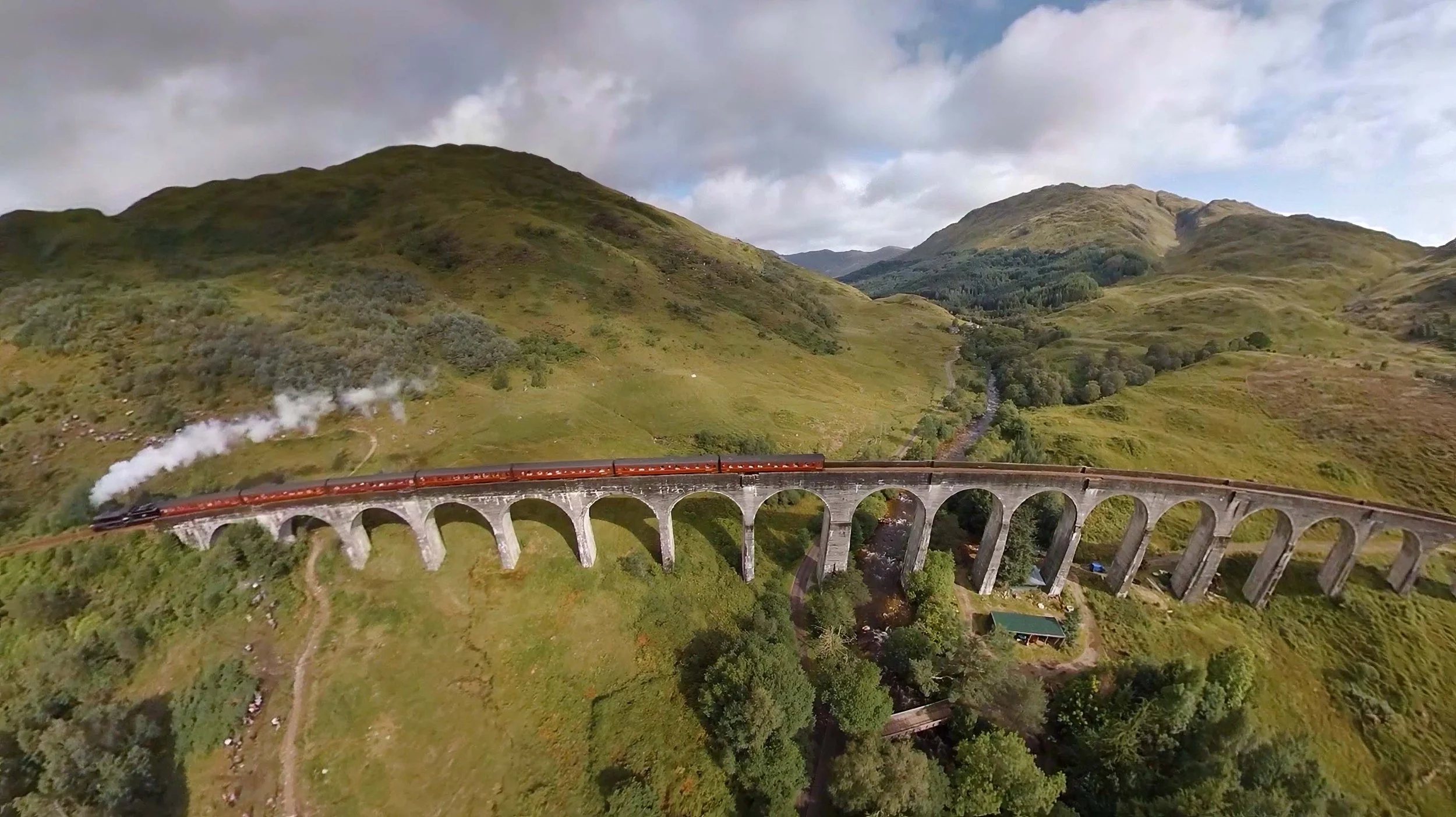
Immersive 360° aerial filming alongside the Jacobite steam train in the Scottish Highlands for CNN VR, using a custom-built invisible-drone system to create the sensation of flying freely around the “Hogwarts Express” and surrounding landscape.
Project Details
Client / Broadcaster: CNN
Production:Hogwarts Express Steam Train VR
Platform: CNN VR
Published: 1 November 2018
Location: Scottish Highlands
Subject: The Jacobite steam train, widely known as the “Hogwarts Express”
Role: 360° Drone Designer, Pilot & Cinematographer — Lewis Whyld
Filming: Immersive 360° aerial cinematography from a custom-built drone system
Technical Approach: Bespoke multi-camera 360° capture system engineered to minimise the visibility of the aircraft in the finished image
Viewer Experience: Free-look immersive footage allowing the audience to look around the train, landscape and flight path rather than being restricted to a conventional camera direction
Operational Challenge: Flying alongside a moving steam train while maintaining a usable 360° composition across the full field of view
Engineering Challenge: Designing the aircraft, camera layout, stabilisation and post-production workflow as a single integrated system
Coverage: The Jacobite steam train, railway route and surrounding Highland landscape
Story Focus: Creating the sensation of flying alongside one of Scotland’s most recognisable heritage trains
Recognition: The wider CNN 360° drone system later received the 2019 Gannett Foundation Award for Technical Innovation in the Service of Digital Journalism at the Online Journalism Awards
Commercial Relevance: Heritage attractions, tourism campaigns, rail, immersive brand experiences, 360° content and productions requiring bespoke camera or aircraft solutions
Specialism: 360° Drone / VR / Immersive Filming / Bespoke Drone Engineering / Heritage / Rail / Tourism / Aerial Cinematography
Engineering an Invisible 360° Drone
Conventional drones are designed around a camera looking in one direction. A 360° camera creates the opposite problem: everything around the aircraft can become part of the image, including the drone itself, its propellers, landing gear and vibration.
For the CNN VR project, Lewis developed a custom aircraft and camera arrangement specifically for immersive aerial capture. Multiple cameras were positioned and synchronised so their images could be stitched together into a complete spherical view, while the drone structure was designed to minimise how much of the aircraft appeared within that sphere.
The system also required a dedicated stabilisation and post-production workflow. Because the viewer could choose where to look after the flight, the aircraft had to deliver usable imagery in every direction rather than relying on a single carefully framed camera angle.
The result was an aerial platform designed around the final viewing experience from the outset, allowing the Jacobite sequence to feel as though the viewer was moving freely through the landscape alongside the train rather than simply watching footage captured from a drone.
Immersive Drone Filming for Heritage, Tourism & Brand Experiences
The Jacobite project shows how immersive drone technology can be used when a conventional aerial shot is not enough. Rather than presenting the train and landscape from a fixed camera direction, the 360° system allowed the viewer to explore the scene freely while moving through it.
For heritage attractions, tourism campaigns, transport brands and experiential projects, that creates opportunities for aerial content that feels closer to being present at the location than simply watching a film. The same approach can be adapted to destinations, railways, visitor attractions, large venues and branded environments where immersion is central to the brief.
The project also demonstrates a wider production capability: when the required shot cannot be achieved with standard equipment, the aircraft, camera configuration and workflow can be developed around the creative objective rather than forcing the idea to fit an existing drone platform.
Related Case Studies
Flying Scotsman — High-speed FPV chase and cinematic aerial filming of one of Britain’s most recognisable heritage locomotives for CNN.
Imperial War Museum London — Fully permitted FPV filming through a major museum and heritage environment, connecting exterior and interior spaces in one continuous flight.
D-Day Normandy — Specialist aerial cinematography across historically significant sites requiring detailed permissions and a restrained visual approach.
Notre-Dame Cathedral — Precision FPV filming inside one of the world’s most sensitive heritage interiors during reconstruction.
Explore All FPV & Drone Case Studies →
Planning Immersive & Bespoke Drone Filming?
Through Whyldthings, I provide specialist FPV, 360° and drone cinematography for productions that need camera movement or perspectives that conventional systems cannot easily achieve.
The Jacobite project combined immersive 360° capture with a custom-built drone platform developed specifically around the final viewing experience, allowing CNN VR to create the sensation of flying alongside the train through the Scottish Highlands.
For unusual commercial, tourism, heritage and experiential briefs, the approach can extend beyond selecting an existing aircraft. Camera systems, aircraft configuration and workflows can be adapted or developed around the creative requirement when standard platforms are not the right solution.
Discuss a Specialist Drone Project